Frequently Asked Questions
Information For
Alzheimer’s Disease and Related Dementias Training – FAQs
Please be advised that the Department reserves the right to amend or adopt new rules related to the establishment of training curricula guidelines and requirements for the approval of other qualified training providers. The following answers are based on current best practices.
Required Training Questions
Who is required to complete the initial one-hour training?
Any employee or volunteer required to undergo a level-2 background screening, and who provides personal care to or has regular contact with persons living with dementia. Examples of this contact include but are not limited to daily interaction, assistance with medications or other activities of daily living, and any services that promote the physical, mental, and psychosocial well-being of participants or residents.
Are volunteers or contractors required to complete the one-hour training program?
Yes. Volunteers or contractors who are required to undergo a level 2 background screening, and who provide personal care to or have regular contact with persons living with dementia must complete the initial one-hour training and then additional training in accordance with their care setting.
Examples of this contact include, but are not limited to, daily interaction, assistance with medications or other activities of daily living, and any services that promote the physical, mental, and psychosocial well-being of participants or residents.
Can a different one-hour training program be used to satisfy the initial training requirement other than the video offered through the Department?
No. Per 430.5025 F.A.C., the initial one hour of training must come from the Department of Elder Affairs. No other curricula may be used to satisfy this new requirement.
Hospice agencies, which were unaffected by the new statute, should continue to develop and use their own one-hour material. Use of the Department-specific one-hour training video is not a requirement for hospice agencies.
Do employees who have previously completed dementia-related training still need to complete the Department’s one-hour training video?
Yes. Employees hired prior to July 1, 2023, will have until July 1, 2026, to complete the Department’s one-hour training video. All employees hired after July 1, 2023, will have 30 days from their hire date to complete the one-hour training.
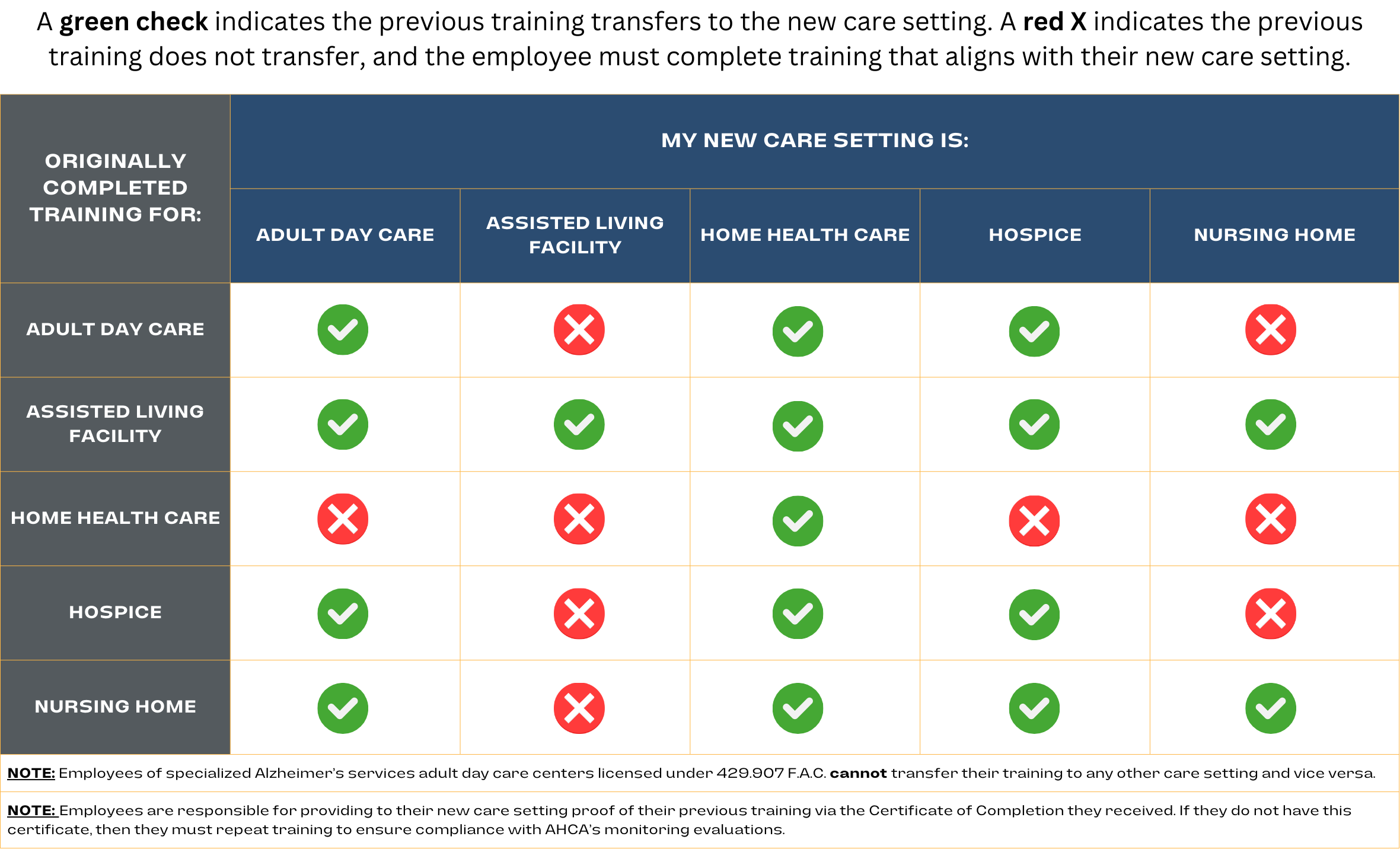
Does an employee need to retake the required ADRD training if they change employers?
This is dependent on which care setting the employee originally received training for, and what their new care setting will be. Please use this chart here to verify whether previous ADRD training satisfies the requirements for the employee’s new care setting or if they must undergo additional training.
What is the difference between “having regular contact with” and “providing personal care to” persons living with dementia?
Personal care means providing assistance with activities of daily living, assistance with self-administration of medication, homemaker or companion services, nursing services, or other services that promote the physical, mental, and psychosocial well-being of participants or residents.
Regular contact means the performance of duties other than personal care that may require employees to interact in-person on a daily basis with participants or residents.
Do employers need to create their own basic written information document, or is there one available through the Department?
Each care setting must provide all new employees with basic written information about interacting with persons living with dementia upon beginning employment. Employers may develop their own content if desired, but the Department has developed content available at no cost available for download here.
Who is required to complete continuing education?
Continuing education for ADRD is required for employees of assisted living facilities, adult day cares, and adult family care homes that offer specialized care (e.g., memory care). The employee must complete at least four hours of continuing education each calendar year through contact hours, on-the-job training, or electronic learning technology. More information on continuing education can be found in the full statute here. The Department does not oversee the approval of continuing education.
Training Provider Questions
Are trainers and curricula that were previously approved by the University of South Florida still approved under this legislation?
Yes. Trainers and curricula approved prior to the effective date (July 1, 2023) are still valid. At this time, ADRD trainer approvals do not expire, and training curricula remain valid until their given expiration date (three years from their initial approval date).
How do I become an approved training provider for the State of Florida?
Complete and submit the online application for the particular care setting you wish to provide trainings for here and upload all required documentation of your credentials and experience.
Is there a training provider application fee?
No, there are no costs associated with the training provider application.
How long does the approval process take?
The review process is typically within 30 days from the date a submission is received. However, the Department may take additional time to review an application if unexpected circumstances warrant a longer review process.
Can I become an approved training provider without a master’s degree, bachelor’s degree, or RN license?
At this time, individuals may be eligible to use years of teaching experience as an educator for caregivers of persons with ADRD to substitute on a year-by-year basis for the bachelor’s degree. You must be able to provide verifiable proof of this experience.
As an approved training provider, in which care settings can I conduct training?
You may only conduct training for the care setting in which you have been granted approval. If you wish to provide training for multiple care settings, please submit an application for each setting.
Curriculum Questions
Are trainers and curricula that were previously approved by the University of South Florida still approved under this legislation?
Yes. Trainers and curricula approved prior to the effective date (July 1, 2023) are still valid. At this time, ADRD trainer approvals do not expire, and training curricula remain valid until their given expiration date (three years from their initial approval date).
My curriculum was originally approved as a four-hour training prior to the effective date (July 1, 2023). The statute now only requires a three-hour training for my care setting. Can I still use this material?
Yes. Curricula approved prior to the effective date are still valid and do not need to be updated or adjusted. If you want to condense the training from a four-hour timeline to a three-hour timeline, then you may do so. However, all content must be taught exactly as it was approved, and no content may be left out. It is the training provider’s responsibility to ensure all content is covered according to each care setting’s associated rule.
Where can I find an approved curriculum that satisfies the ADRD training requirements for my care setting?
A list of approved curricula with contact information for the creators may be accessed here. It is up to you to make contact with the creators to determine who is offering their curriculum for purchase and at what cost.
How do I submit my own curriculum for approval?
Complete and submit the online application for the particular care setting you wish to create content for here and upload all required documentation.
Is there a curriculum application fee?
No, there are no costs associated with the curriculum application.
How long does the approval process take?
Upon receipt, the curriculum will be forwarded to a subject matter expert for content review. The review process is typically within 30 days from the date a submission is received. However, the Department may take additional time to review an application if unexpected circumstances warrant a longer review process.
Once the curriculum has been reviewed by a subject matter expert, the applicant will be given an approval letter or sent a More Information Needed request should the reviewer determine irregularities of any kind. The following are examples of irregularities: misinformation, incomplete information, out of date information etc.
Are there special requirements for self-study or online curriculum?
Yes. These types of curricula must have a post-test and provide the name of an approved training provider with whom the trainee may engage with questions. The trainer’s name, approval number, hours, and method of contact must be included.
Online curricula must provide a full transcription of the course or screen shots of the material. If available, a link to view the training should be provided, along with a log-on and password for review of functionality and organization of the material. This version of the curriculum must allow the reviewer to advance forward and backward.
What about copyright material?
It is the responsibility of the curriculum developer to ensure that no copyright laws have been violated if material from another source is used as part of the curriculum.
Are pre- and post-tests required?
At this time, only online curricula are required to have post-tests. However, it is always highly recommended to measure the transfer of knowledge.
Does my curriculum have to meet a specific time standard?
Yes. To gain approval, you must provide a timeline of how the required content will be taught within the designated time requirement mandated for your specific care setting. Your content is allowed to be longer than what is required of your care setting; however, it may not be any shorter than what is mandated in F.A.C. 430.5025.
Can breaks, pre- and post-tests, discussion sessions, or evaluations be included as part of the total time required for the curricula?
Break times cannot be included.
Pre- and post-tests may be included but should not exceed 5 percent of the total instruction time.
Discussion sessions may be included. Pre-planned questions along with their expected answers should be submitted for review.
Content review may be included and should be within the same 5 percent of total instructional time that is used for pre- and post-tests.
Satisfaction questionnaires that focus on evaluating the trainees’ opinions on the content, style, environment, etc., of the training cannot be included.
Once my curriculum is approved, in which care settings can it be used?
You may only use your curriculum for the care setting in which you have been granted approval. If you wish to develop curricula for multiple care settings, please submit an application for each setting.
General Questions
I received approval as a training provider and/or for my curriculum, but I don’t see myself listed on your website.
If you have not kept your contact information current, then we have removed you from our public listing. If you need to update your contact information, please email ADRDtraining@elderaffairs.org. This list is updated on a weekly basis, so please allow up to seven calendar days for any requested changes to be reflected.
Curricula expire every three years from their given approval date and are removed upon their expiration. This is to keep the public listing of curricula representative of what is currently approved and in-use.
I still have additional questions that were not answered here.
Please email your questions to ADRDtraining@elderaffairs.org. It is also advised to periodically check back to see what updates, if any, have been made to the FAQ listing.
Elder Law – FAQs
Below are frequently asked questions about legal topics and how clients can prepare for upcoming appointments with legal service providers.
If you have additional questions, please contact the Senior Legal Helpline at 1-888-895-7873.
What should I bring to my legal services appointment?
What should I do if I am the victim of a scam?
Background Screening – FAQs: Exemption from Disqualification Process
Frequently asked questions for applicants applying for an exemption from disqualification for: as a DOEA Direct Service Provider.
Who is required to have an exemption from DOEA?
The Department reviews applications and makes decisions on Exemptions for:
- All Direct Service Providers;
- This may include licensed personnel not working within the scope of their license (for example: a CNA working as an HHA).
Who is required to have an exemption from the Florida Department of Health?
The Florida Department of Health reviews applications and makes decisions for licensed and certified health care professionals, if that person is working in the scope of his or her license or certification (for example: CNA, LPN, RN). For more information regarding the exemption process for licensed or certified individuals with the Department of Health, visit http://www.floridahealth.gov/, or call 850-245-4444.
Is there an application fee?
There is no fee for the Application for Exemption from Disqualification.
Where do I send the exemption application and other documentation?
All documents are required to be legible and in English, to apply:
- Scan and email all documents to doeanetwork@elderaffairs.org or
- Fax to 850-617-6595 or
- Department of Elder Affairs, Background Screening Unit, 4040 Esplanade Way, Tallahassee, FL 32399-7000
- The Department has 30 days to decide once all required or relevant documentation has been received deeming the application complete.
Why does the “not eligible” letter list my non – disqualifying offense(s)?
The “not eligible” letter will list all offense(s) from the first disqualifying offense of an individual. To be considered for an exemption, information for all offenses on your criminal history is required.
What is the 30-day timeframe mentioned in the “not eligible” letter?
https://ahca.myflorida.com/MCHQ/Central_Services/Background_Screening/BGS_results.shtml All applicants have 30 days from the date of receipt of their “not eligible” letters to apply for an Exemption; however, if an extension is needed, please contact the Background Screening Unit. This only applies to individuals seeking employment as a DOEA Direct Service Provider.
Is a Level II screening the same as a criminal history report?
Yes, they both contain state and national checks for offenses. All candidates required by law to be screened pursuant to this section must undergo security background investigations as a condition of employment and continued employment which includes, but need not be limited to, fingerprinting for statewide criminal history records checks through the Department of Law Enforcement, and national criminal history records checks through the Federal Bureau of Investigation and may include local criminal records checks through local law enforcement agencies.
What if I cannot obtain all the arrest reports, court dispositions, probation information and/or other information required?
You must try to obtain this documentation from the Clerk of Courts office, probation office or arresting agency. Documentation from the Clerk of Court and/or the arresting agency must be provided on their letterhead indicating the document(s) are no longer available. You must also provide a signed notarized statement explaining the details of the arrest and the outcome, to include probation or sentencing information, court fees/fines and restitution for each offense for which you are unable to obtain complete documentation.
What is rehabilitation?
Rehabilitation includes successful completion of court-ordered treatment, counseling program, education, and training certificates; proof of participation in community activities; and special recognition or awards received. Rehabilitation can also be demonstrated by voluntary participation, as well.
Are there criteria or things that needs to be included in the Letter of Recommendation?
One reference letter must be from a current or most recent employer on the employer’s letterhead. Other letters must be from individuals you have known for at least two years through contact at the workplace, community activities, education or training centers. Individuals providing a Letter of Recommendation should include their name, address and telephone number for verification or possible interview. In addition, each letter of recommendation must be signed and dated within 6 months of your application submission.
How do I appeal if I am denied the exemption?
A certified letter is mailed to the address on the exemption application. You have 21 days from the date you sign for the certified letter to request an appeal.
- Pursuant to Section 120.569, F.S., you have the right to request an administrative hearing within 21 days of your receipt of this letter. In order to obtain a formal proceeding before the Division of Administrative Hearings under Section 120.57(1), F.S., your request for an administrative hearing must conform to the requirements in Section 28-106.201, Florida Administrative Code, and must state the material facts you dispute.
- Pursuant to Florida law, you have the right to re-apply for an exemption at any time. There are no limits as to the number of times you may apply for an exemption.
Can an exemption from another Florida state agency be considered?
Each specified agency makes their own decisions regarding exemptions. If you have received an exemption from another state agency you may submit a copy with your application.
Background Screening – FAQs: Specific to Web PortalReports
What is the purpose of registering for the Web Portal?
The purpose of the Portal is to provide Area on Agencies on Aging, Aging Resource Centers, Lead Agencies, Services Providers, and Diversion Providers that contract directly or indirectly with the Department with the ability to independently view and print the results for all screenings completed.
You will be able to view and print screening details (results) twenty-four (24) hours a day, seven (7) days a week.
You will be able to search for screening results for prospective candidate screened by other providers.
After registering for the Portal, please take some time to familiarize yourself with the Portal User Guide. You will find the Guide posted on the Portal Home Page.
What information will I need to have at-hand to register for the Portal?
You must have already been added to the DOEA – Provider List before you may register for the Portal. The Provider List will create a unique number for your entity that is specific to only the Department of Elder Affairs. To register for the Portal, you must log into the Clearinghouse, Request Program Access to the Department of Elder Affairs and follow the prompts.
*If you have not, yet, been added to the DOEA – Provider List and given a number, please click on the link titled Contact Us and provide us with descriptive and contact information for your program and the Area on Agencies on Aging or Lead Agency that you are contracted with. A template will be sent to you to complete and return to the doeanetwork@elderaffairs.org
Can multiple staff members, of one facility (provider), be granted Portal access?
Yes. Multiple employees, of the same provider, can register for the Portal. Each employee is required to provide the same information to request Portal access (Provider number, first and last name and business email address).
What is the best way to remember my username for Portal access?
Each user must create their individual account.
The Background Screening Unit can assist you with your log-on Id name, however, you are required to manage your own password.
Usernames and passwords CANNOT be shared with other users.
What must I remember about creating my password?
Passwords must be 8 – 20 characters in length and must contain at least 1 letter and one number and one special character of your choice, such as the following: #, @ % ~ ? : !
After the first time I register, do I need to re-register again? What if I haven’t used the Portal for a long time?
It is only necessary to register once. There is no need to repeat your registration, for any reason.
If you have not used the Portal in a long time you will be required to reset your password.
What if I forget my password? Must I always call the Background Screening Unit to reset my password?
If you forget your password, stop after the second failed attempt and click the field titled Forgot Password? You will be asked to enter your username (last name-first name) and answer a security question that you chose when initially registering for the Portal. It is important that you write down the answers to your security questions to ensure you have the correct answers to permit you to independently reset your password. Three failed password attempts will require you to contact the help line in order to reset your password.
What can I do if I cannot find results for an individual fingerprinted within the last 90 days?
There are two actions you can take to locate missing screening results.
Background Screening Provider Search
The Background Screening Provider Search permits you to search for a candidate who has been fingerprinted by another provider or find screening results that do not display under your provider account. To determine if your missing results, follow Background Screening Provider Search instructions (User Guide, pages 6 and 7) to search for your missing screening results. After entering the four (4) applicant identifiers (first and last name and date of birth and Social Security number). click on the Search button. Click on the candidate’s name, highlighted in blue, and the Candidate Screening Detail will appear.
Contact the Background Screening Help line at 850-414-2093
If your Background Screening Provider Search (above) fails to produce any results for a Candidate screened within the past 90 days, contact the Background Screening Unit for assistance.
Can I look up screening results for an applicant screened by another facility within the past 90 days? If so, can I use those screening results to hire the applicant for my program?
A Portal user may look up a screening result for anyone printed within the past 90 days. To do so, follow the same instructions, above, to search for an applicant through the Background Screening Provider Search. As explained, above, you will need to enter the four (4) Candidate identifiers (first and last name and date of birth and Social Security number). However, you will not be able to receive the Florida Department of Law Enforcement Criminal History Public Record.
You may be able to use the letter of a cleared applicant, screened by another program, if the applicant met Level 2 screening standards for your program and there has not been a 90 day break in service (employment). It is recommended that prospective employers clarify the acceptance of a clearance, completed by another program, with the appropriate specified agency.
What if an applicant was granted an exemption? Will I find a copy of a granted exemption letter on the Portal?
No. Information regarding a candidate’s granted exemption will never appear on the Portal. However, the candidate’s profile page will state Eligible under Determination with a date of the change. The Clearinghouse will generate an email to the Contact person notifying them of a change within the system for the individual.
What does the Fingerprints Rejected result mean?
When a candidate’s fingerprints cannot be read by the FBI, the print results are classified as rejected. A second set of prints is required by the FBI. The entity (provider) needs to print the rejection letter from the Portal. The candidate must take the rejection letter to the same livescan vendor who will reprint the candidate. The rejection letter contains important information, including a unique code number that is needed in order to avoid additional payment for the reprinting. If the second set of prints, also, results in rejection, then the department is required to submit an candidate name search to the FBI. This is the responsibility of the specified agency, not the entity (provider). The FBI routinely requires 30 to 45 days to complete a name search. When the department receives the FBI’s completed name check results, then the eligibility determination will be posted on the Portal, by the department, for retrieval by the provider.